Restoring image bearers at work.
Why workplace leadership and discipleship are not two separate callings — and what changes when you treat them as one.
Listen to Essay
Restoring Image Bearers at Work
The Divide
Most people live with an invisible wall between Sunday and Monday. Ministry is what happens at church. Work is what pays the bills. And the two rarely touch.
Sunday
Discipleship is relational, patient, focused on character transformation.
But it often lacks organizational rigor, accountability structures, and scalable systems.
Monday
Organizational leadership builds systems, drives outcomes, develops people.
But it rarely considers the soul beneath the performance — or the mission beneath the metrics.
This divide shapes how leaders think about their own significance. A pastor counseling someone through grief feels like they're doing God's work. A project manager coaching a struggling team member through a hard quarter does not. But should they? The sacred-secular divide costs us on both sides — and both lose.
80k
hours spent at work per lifetime. If that time is spiritually inert, the church's most powerful formation context goes entirely unused.
The Mission
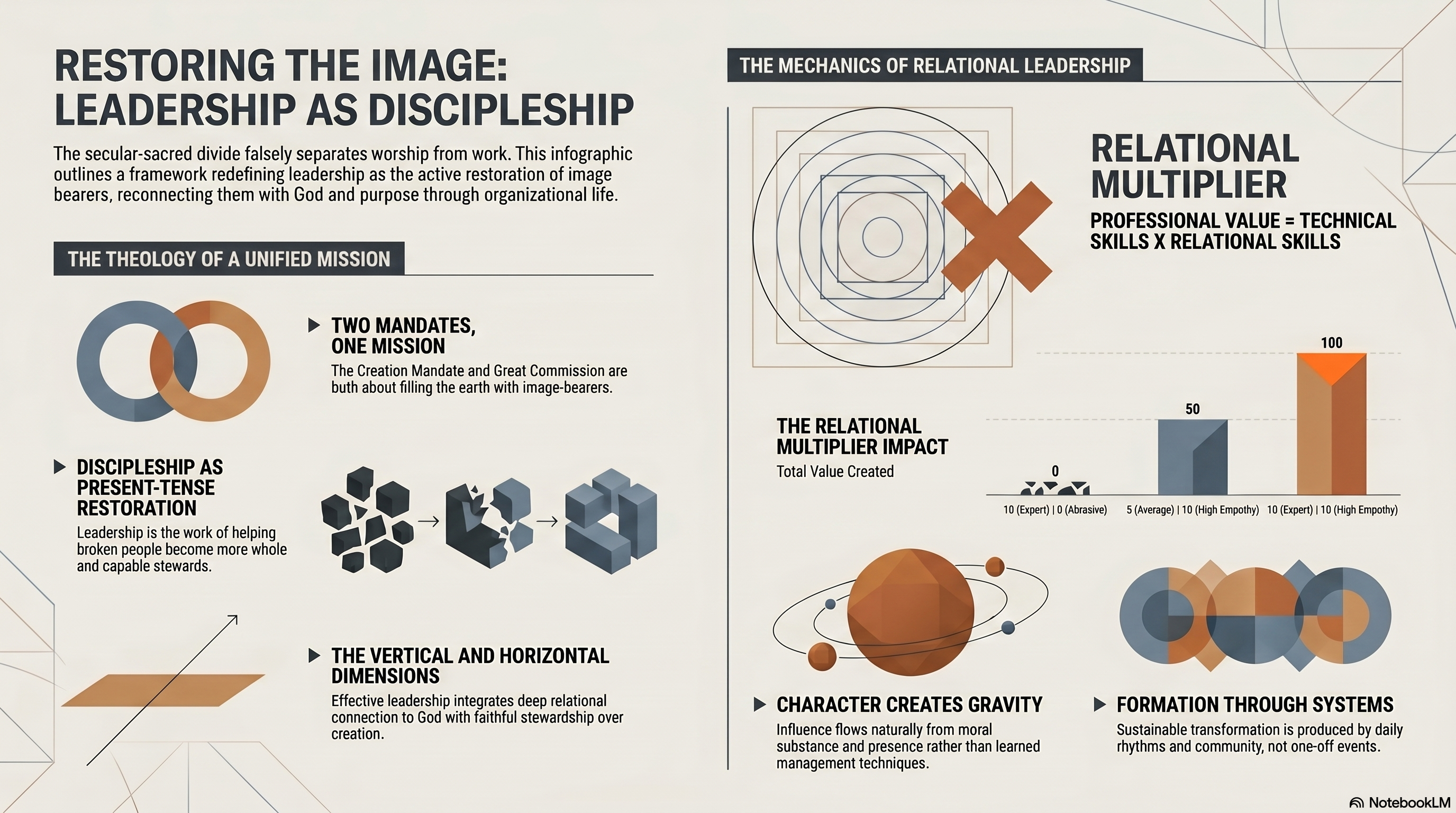
God's mission — from Genesis through Revelation — is singular and unchanging: to fill the earth with whole image bearers who are deeply connected to Him and exercising faithful stewardship over creation.
The Creation Mandate of Genesis 1:26-28 — be fruitful, multiply, fill the earth, exercise dominion — wasn't cancelled by the Fall. It was interrupted. The Great Commission picks up exactly where it left off: making disciples of all nations is the spiritual continuation of filling the earth with image bearers. What Adam disrupted through disobedience, Jesus restored through obedience.
Discipleship is therefore present-tense restoration — helping broken image bearers become more whole, more connected to God, and more capable of stewarding what He's placed in their hands. And this mission integrates two dimensions that cannot be separated. The vertical — deep relational connection with God. The horizontal — faithful stewardship over creation. Relationship without stewardship leaves creation unmanaged. Stewardship without relationship attempts dominion disconnected from its authority source. The Fall broke both simultaneously. Jesus restores both.
The question is not whether workplace leadership relates to God's mission. It's whether we have eyes to see it.
Every human being is an image bearer — inherently mission-oriented, carrying God's capacity for intentional, purposeful action through mind, will, and emotions. The universal restlessness people feel without meaningful work confirms this design. People aren't just looking for a paycheck. They're looking for significance and security — because that's what image bearers do.
Two mandates, one mission
Genesis 1:26-28
Be fruitful. Multiply. Fill the earth. Exercise dominion. The original design: whole image bearers connected to God, stewarding creation.
INTERRUPTED, NOT CANCELLED
Matthew 28:18-20
Go. Make disciples. Baptize. Teach. The spiritual continuation: multiplying restored image bearers across all nations.
"The question shifts from 'What shall we create?' to 'What is God already doing, and how do we join?'"
What People Actually Need
The longing beneath the surface
Every unsatisfied desire at work — the hollow feeling after a promotion, the emptiness after hitting a target — points beyond temporal fulfillment toward something ultimate. This isn't a flaw. It's evidence of design.
The brokenness beneath the dysfunction
A combative employee's defensive posture may mask chronic invisibility from years of unmet developmental needs. The diagnostic question shifts: not "what's wrong with this person?" but "what happened to this person?"
The identity beneath the performance
Performance-driven identity exhausts the soul. Fruit grows naturally from a healthy tree rather than being pinned as decorations to a dead one. The grammar matters: "I am God's beloved who struggles," not "I am a struggler."
Surface symptoms at work — disengagement, toxicity, poor coordination — always manifest deeper relational disconnection: from God, from true self, from others. People don't leave their brokenness at the office door. They bring it to every meeting, every project, every conversation. The same longing and desire for significance that drives them to church on Sunday drives them to work on Monday.
This is why behavioral modification fails — in churches and in organizations. The actual blockage isn't technique deficiency or unprocessed trauma. It's flesh patterns demanding life from sources other than God. Changed beliefs about who they are, whose they are, and what work is for produce changed actions. Moralistic approaches feel hollow because they target symptoms rather than root causes.
The Relational Multiplier
Professional value equals technical skills multiplied by relational skills — not added. A 10-rated expert with zero relational ability produces zero value.
This explains why organizations tolerate mediocre technical performance from relationally skilled people while forcing out brilliant but abrasive experts. Rhode Island Hospital had excellent surgeons but preventable deaths: toxic communication patterns where nurses couldn't question doctors created coordination failures that no amount of individual talent could overcome.
The org leader says
"Relational health is our competitive advantage."
The disciple-maker says
"Relational holiness is other-centered love."
They're describing the same capacity. One measures it in retention and productivity. The other measures it in Christlikeness. Both are right.
The formula
Tech
Skills
×
Relational
Skills
=
Value
Created
Character development isn't optional enrichment — it's structural to professional impact.
Relational wisdom compounds
God-intimacy, valued counsel, and compelling witness amplify each other exponentially. Someone with modest relational technique but strong God-intimacy wields greater influence than a skilled communicator operating from personal resources alone.
The Leader's Posture
The most transformative leadership posture is that of a struggling elder joining someone on their journey — not an expert administering treatment from above.
Not this
Expert administering treatment from above
Positional power compels compliance but cannot invite vulnerability.
The shift
Fellow traveler
not detached authority
This
Struggling elder joining the journey
Experience and maturity matter — while refusing to pretend arrival.
Character creates gravity
Character operates as a natural force — not learned technique. Just as water only flows naturally when actual elevation difference exists, character influence flows only when actual moral substance exists. Truth is the summit of being; influence flows from that height.
Presence over credentials
When people hurt, an understanding friend fully present outperforms a credentialed therapist applying technique at distance. What enables one person to nourish another's soul has nothing to do with training, degrees, or licenses — everything to do with the quality of presence.
Vulnerability as catalyst
The life of Christ in one person calls forth the life of Christ in another. People hide behind controllable resources — wit, expertise, achievements — to avoid presenting themselves as mere persons. But what we most fear losing (control through competency) is what most prevents gaining what we most want (being known and knowing others).
Observable transformation persuades
A father skeptical about Christianity was unconvinced by arguments but concluded "there must be a God" when observing his son's pride replaced by humility. The most powerful apologetic is not a well-crafted argument. It's a visibly changed life in a context where people knew who you were before.
The tensions to hold
Care balanced with standards
Care without standards creates dependency. Standards without care creates compliance without commitment.
Listening as strength
Deep listening requires courage to enter another's reality without having solutions ready — dwelling without needing to resolve.
Visible growth creates trails
Internal growth that remains invisible produces no modeling effect. Growth trajectory functions as public leadership infrastructure.
Systems That Restore
Transformation isn't produced by events. It's produced by daily rhythms sustained over years. The early church grew through daily teaching, daily fellowship, daily breaking bread, daily prayers — culture, not campaigns.
Three layers of soul care
Soul care requires three distinct relational layers that cannot be replaced by professional therapy or corporate HR programs. Friendship — caring engagement made possible by genuine connection. Shepherding — mentoring from experienced people who provide hope through survived difficulties. Spiritual direction — discerning the soul's deepest movements with sensitivity to the Spirit's work. All three happen naturally in healthy workplace teams when leaders intentionally foster relational depth.
Community as transformation mechanism
Connected community stands at the center of transformation because connected community is the defining center of God. The Trinity reveals that humans are inherently relational beings created for community — as essential infrastructure for authentic human existence. Individual identity reaches its fullest expression only through committed relationships that mirror God's eternal relational nature. Transformation methods that bypass community miss the structural center of reality.
Delegation that develops
Outcome-based delegation — "Get that client to approve the project by Friday" rather than "Email that client" — empowers ownership. A 90% solution fully owned by a team member builds more capability than a 100% solution you touched. The instinct to improve everything signals distrust and kills initiative. When team members know their work will be edited, they stop taking full responsibility and submit drafts rather than finished work.
Teaching plus community
Spiritual maturity — and leadership maturity — emerge from two interdependent contexts that cannot substitute for each other. Systematic teaching provides the confrontational clarity of truth. Relational community provides the safety for mutual truth-sharing. Jesus formed disciples not through lectures but by inviting them into shared ministry experiences — watching Him interact with people, physically distributing food, witnessing prayer struggles. Principles become concrete when mentors allow others to observe them navigate actual decisions.
The apprenticeship timeline
The Jewish Talmidim system required fifteen years of immersion with the explicit goal of "becoming who the rabbi is" — not just learning his knowledge. This signals something critical: transformation from student to teacher requires sustained immersion in both content mastery and identity formation.
If the goal is producing leaders who embody what they teach, the timeline cannot be rushed. Modern leadership development programs measured in weeks or months may produce knowledgeable adherents but not transformed leaders.
Building beyond yourself
Organizations that survive leadership transitions rely on systems that produce aligned successors, not on the irreplaceability of individual leaders. When institutions invest in training pipelines that nourish by the same teachings and inspire by the same principles, they create redundancy at the leadership level.
Organizations that celebrate irreplaceable leaders are advertising their fragility. True institutional strength shows when leadership changes are barely noticed.
The Power Source
"Apart from me you can do nothing." The constraint is absolute: no abiding equals zero fruitfulness — not reduced fruitfulness. Zero.
God's power to change others flows most freely when we stop self-dependent striving and instead relate from deep fellowship with Christ. The paradox: we access transformative spiritual power by releasing our grip on outcomes and abiding in connection with God. Exhaustion signals we're in the wrong power source.
Paul's model captures it precisely: "presenting people mature in Christ while working in the energy of Christ who so powerfully works in me." This establishes the crucial distinction between doing good through human effort alone versus relationally holy engagement requiring divine energy through the Holy Spirit.
Three circles of impact
Abiding produces personal transformation (your own character), communal influence (encouragement and challenge for those around you), and countercultural witness (a life that makes onlookers take notice). All three flow from the same source but manifest at different scales.
Grace received becomes grace given
A person maintaining a self-image of competence while intellectually affirming grace has nothing visceral to pass along. Brokenness — honest recognition of relational failures toward those closest — creates the felt gap between deserving and receiving that makes grace transferable.
Divine love defies transaction
After 39 chapters of legitimate complaints against Israel, God's next word is "comfort my people." Full exposure of sin's ugliness makes subsequent comfort more stunning. Divine love neither overlooks offense nor withdraws after cataloging failures. It acknowledges offense while choosing restoration.
The gospel provides what no secular leadership model can — motive, pattern, and power for relational transformation in a sequence that actually works:
Motive
God sent His son; we respond in obedience, not obligation.
Pattern
"While we were still sinners Christ died for us" — initiating relationship despite offense.
Power
Recognition of our inability leads to dependence on the Holy Spirit for transformation beyond natural capacity.
The Holy Spirit is the Spirit of the relationship between the Father and Son. When the Spirit dwells in believers, He brings the relational dynamic of the Godhead into human hearts. This is why believers can love beyond natural capacity — they host the Spirit of the Father-Son relationship itself. When we attempt natural solutions to supernatural problems, we guarantee failure and frustration.
Suffering as Formation
God prioritizes battling soul disease over relieving circumstantial suffering. This reframes every workplace hardship, every organizational crisis, every difficult season.
Severe adversity strips away the comforts and distractions normally occupying consciousness, creating desperation that opens awareness to God's presence inaccessible during prosperity. People consistently report experiencing God during difficulty with an intensity never encountered in comfortable circumstances. The mechanism operates through elimination: comfort insulates consciousness from existential dependence. This explains why the way up spiritually often requires descent into suffering.
Leaders who reframe organizational adversity as opportunity for character formation — rather than a problem to escape — model the faith their organizations need. Rather than minimizing difficulty or demanding quick solutions, they ask: "What is God forming in us through this?"
Framing life between the Cross and the Coming — rather than birth and death — fundamentally changes the response to suffering. When bounded by birth and death, every unmet desire feels like permanent loss. When bounded by Cross and Coming, unmet desires become temporary, enabling leaders to yield their demands for things to go right in the present.
This eschatological hope produces endurance, not passivity. Moses abandoned princely comfort for decades of wilderness leadership because of future hope. Jeremiah persevered through suffering because he trusted everything would eventually be made right. The consistent pattern: eschatological hope produces active endurance — people who work harder, not less, because their efforts connect to something ultimate.
The reframe
Conventional view
Suffering is a problem to solve. Organizational hardship means something went wrong. Minimize it. Fix it. Move on.
Formation view
Suffering becomes a training ground for spiritual formation. Trials strip away surface-level commitments, exposing what truly motivates people. Mixed motivations become visible when suffering removes external rewards.
"Nothing quite clears the mind like a walk up the gallows. Non-essential concerns fall away and what truly matters becomes crystal clear."
Samuel Johnson
The Integration
The workplace becomes a mission field when leaders recognize that the people they lead are image bearers being restored — and that their primary task is nurturing Christ's buried image beneath the dysfunction.
This doesn't require a Bible study in the break room. It requires a leader who abides in Christ visibly enough that their character creates gravity. Who knows their people deeply enough to see God's design in them and call it forth. Who creates space for the three layers of soul care — friendship, shepherding, spiritual direction — through the normal rhythms of work.
When we long to see that little bit of Jesus develop and mature in others, our connections transform from comfort-maintenance to glory-excavation.
The most important question for any leader is not "How do I optimize performance?" It's "What did you do with the relationships I put around you?" Every person on your team represents capital that God has entrusted for kingdom investment. Consistent small investments create relational permission that enables ministry in crisis moments. The eternal weight of a person infinitely exceeds any temporal deliverable.
The unified framework
See image bearers being restored — not resources being managed.
Build relational depth where people experience genuine connection.
Address soul-level disconnection beneath surface symptoms.
Model grace-rooted accountability — truth-telling with commitment to restoration.
Depend visibly on God's Spirit rather than human competence.
Build systems that outlast you — successors who embody, not just repeat.
A Final Word
Mission flowing from duty produces resentment-driven ministry and sustainable burnout. Mission flowing from being alive with God's love creates sustainable joy.
The doing flows from the being — never the reverse. God uses imperfect people. Solomon wrote inspired Scripture while living patterns that contradicted his own wisdom. Our sufficiency comes from God — not from having everything figured out. The question is not "Am I good enough?" but "Am I willing to say yes before I know the assignment?" Through the Holy Spirit, power follows willingness.
Every leader carries a choice. See the people on your team as headcount to be optimized — or as image bearers whose buried glory is waiting to be excavated. The leader who chooses the second path will, paradoxically, produce better results than the one who chases the first. Because when people are truly seen, truly known, and truly developed — not for what they produce, but for who they're becoming — they give everything they have. Not out of obligation. Out of love.
Continue the conversation
This is what I think about at work.
If this resonates — if you lead a team and wonder whether there's something deeper available in how you develop people — I'd welcome the conversation.